
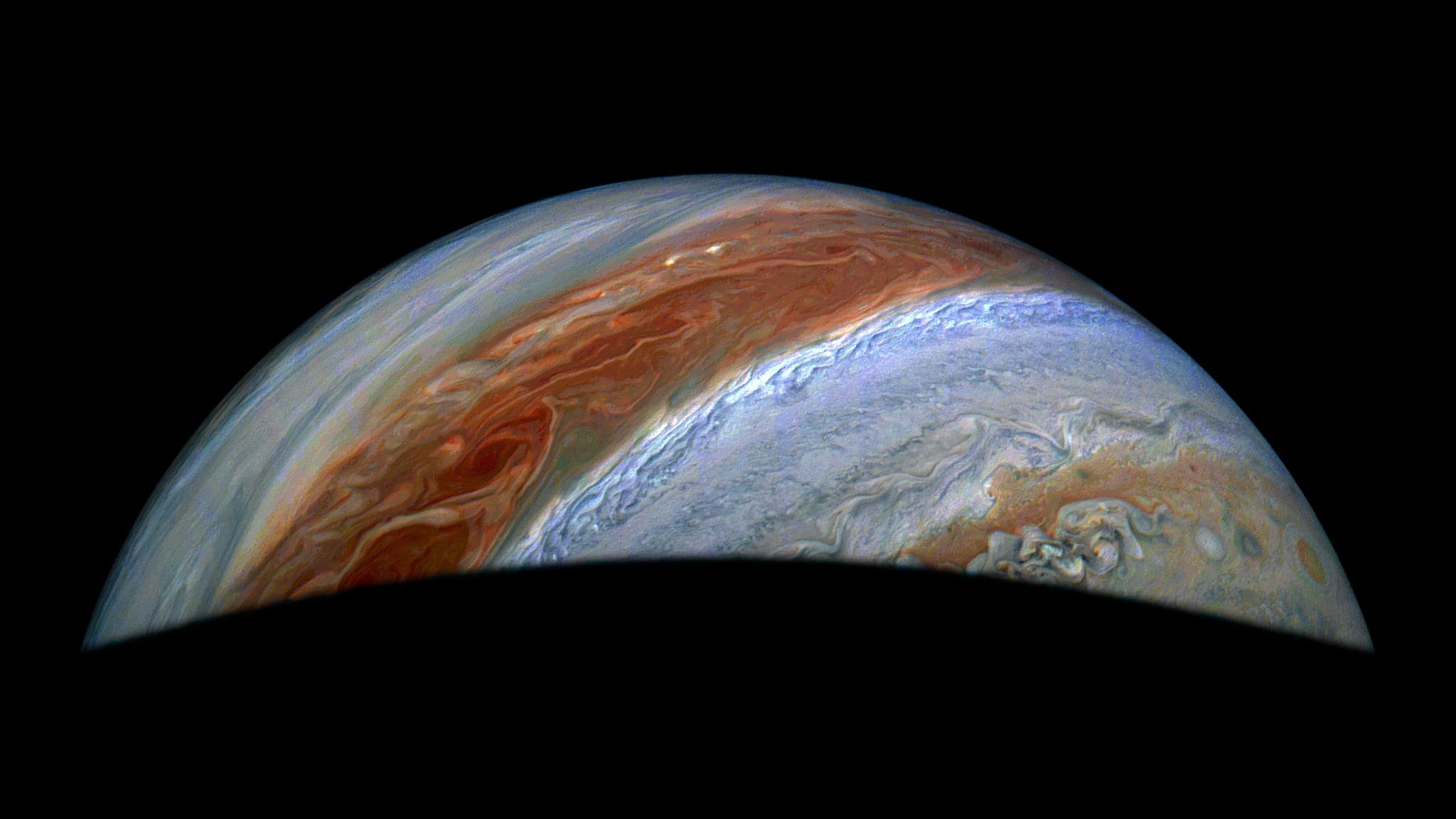
JunoCam, the visible light imager aboard NASA’s Juno spacecraft, captured this view of Jupiter’s northern high latitudes during the spacecraft’s 69th flyby of the giant planet on Jan. 28, 2025. Jupiter’s belts and zones stand out in this enhanced color rendition, along with the turbulence along their edges caused by winds going in different directions.
The original JunoCam data used to produce this view was taken from an altitude of about 36,000 miles (58,000 kilometers) above Jupiter’s cloud tops. JunoCam’s raw images are available for the public to peruse and process into image products. Citizen scientist Jackie Branc processed the image.
Since Juno arrived at Jupiter in 2016, it has been probing beneath the dense, forbidding clouds encircling the giant planet – the first orbiter to peer so closely. It seeks answers to questions about the origin and evolution of Jupiter, our solar system, and giant planets across the cosmos.
Learn more about NASA citizen science.
Image credit: Image data: NASA/JPL-Caltech/SwRI/MSSS; Image processing: Jackie Branc (CC BY)
Hence then, the article about jupiter s turbulent atmosphere was published today ( ) and is available on NASA ( Middle East ) The editorial team at PressBee has edited and verified it, and it may have been modified, fully republished, or quoted. You can read and follow the updates of this news or article from its original source.
Read More Details
Finally We wish PressBee provided you with enough information of ( Jupiter’s Turbulent Atmosphere )


Also on site :
- SEM Scanning Crosses the Global Guideline Threshold: Elevated to Recommended Pressure Injury Prevention Technology
- 50mph speed limits and double cost of second homes: What Burnham should do in first 100 days, according to Labour pressure group
- Oscars: Switzerland Selects ‘Who is Still Alive’ About Palestinians Who Escaped Humanitarian Crisis in Gaza