
2 min read
Origins Uncertain: ‘Skull Hill’ RockWritten by Margaret Deahn, Ph.D. Student at Purdue University
Last week, NASA’s Mars 2020 rover continued its journey down lower ‘Witch Hazel Hill’ on the Jezero crater rim. The rover stopped along a boundary visible from orbit dividing light and dark rock outcrop (also known as a contact) at a site the team has called ‘Port Anson’. In addition to this contact, the rover has encountered a variety of neat rocks that may have originated from elsewhere and transported to their current location, also known as float.
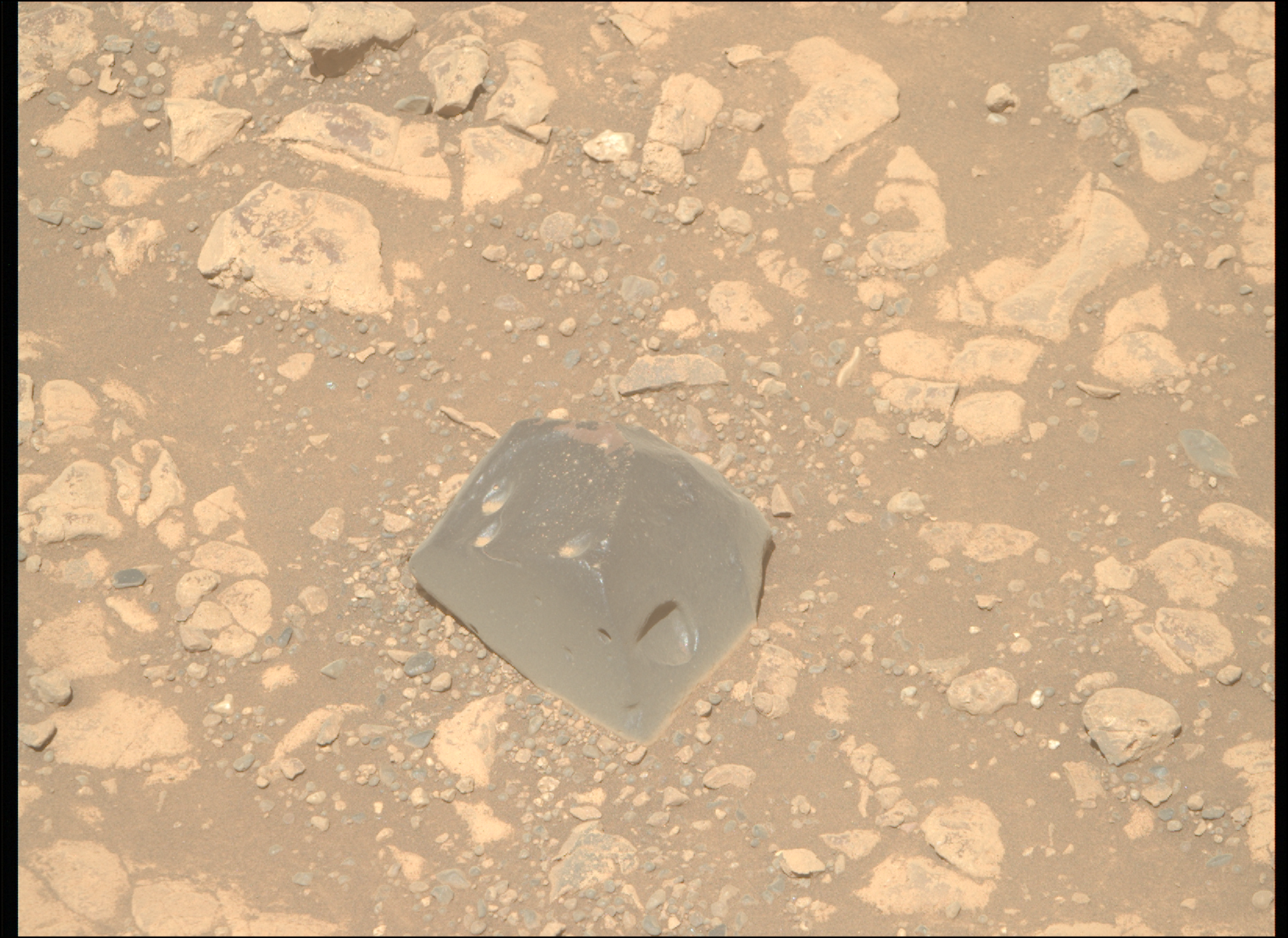
This image from NASA’s Mars Perseverance rover, taken by the Mastcam-Z instrument’s right eye, shows the ‘Skull Hill’ target, a dark-toned float rock. The rover acquired this image while driving west downslope towards lower ‘Witch Hazel Hill’. Perseverance acquired this image on April 11, 2025, or sol 1472 of the Mars 2020 mission NASA/JPL-Caltech/ASUPictured above is an observation named ‘Skull Hill’ taken by the rover’s Mastcam-Z instrument. This float rock uniquely contrasts the surrounding light-toned outcrop with its dark tone and angular surface, and it features a few pits in the rock. If you look closely, you might even spot spherules within the surrounding regolith! See Alex Jones’ recent blog post for more information on these neat features: science.nasa.gov/blog/shocking-spherules/. The pits on Skull Hill may have formed via the erosion of clasts from the rock or scouring by wind. We’ve found a few of these dark-toned floats in the Port Anson region, and the team is working to better understand where these rocks came from and how they got here.
Skull Hill’s dark color is reminiscent of meteorites found in Gale crater by the Curiosity rover: www.jpl.nasa.gov/news/curiosity-mars-rover-checks-odd-looking-iron-meteorite/. Chemical composition is an important factor in identifying a meteorite, and Gale’s meteorites contain significant amounts of iron and nickel. However, recent analysis of SuperCam data from nearby similar rocks suggests a composition inconsistent with a meteorite origin.
Alternatively, ‘Skull Hill’ could be an igneous rock eroded from a nearby outcrop or ejected from an impact crater. On Earth and Mars, iron and magnesium are some of the main contributors to igneous rocks, which form from the cooling of magma or lava. These rocks can include dark-colored minerals such as olivine, pyroxene, amphibole, and biotite. Luckily for us, the rover has instruments that can measure the chemical composition of rocks on Mars. Understanding the composition of these darker-toned floats will help the team to interpret the origin of this unique rock!
Explore More
2 min readSols 4511-4512: Low energy after a big weekend?
Article 2 days ago3 min read
Sols 4509-4510: A weekend of long drives
Article 2 days ago2 min read
Sols 4507-4508: “Just Keep Driving”
Article 6 days agoKeep Exploring
Discover More Topics From NASA
Mars Resources
Explore this page for a curated collection of Mars resources.
Rover Basics
Each robotic explorer sent to the Red Planet has its own unique capabilities driven by science. Many attributes of a…
Mars Exploration: Science Goals
The key to understanding the past, present or future potential for life on Mars can be found in NASA’s four…
Mars 2020 Perseverance Rover
Hence then, the article about origins uncertain skull hill rock was published today ( ) and is available on NASA ( Middle East ) The editorial team at PressBee has edited and verified it, and it may have been modified, fully republished, or quoted. You can read and follow the updates of this news or article from its original source.
Read More Details
Finally We wish PressBee provided you with enough information of ( Origins Uncertain: ‘Skull Hill’ Rock )


Also on site :
- Jeff Ross Shares Throwback With Bob Saget, Norm MacDonald, and Gilbert Gottfried — But Fans Notice One Thing
- At 68, Shaun Cassidy Jokes He’s the Rip Van Winkle of Teen Idols — ‘Looks More Like Shirley Jones Now’
- Brian Austin Green Vulnerably Shares ‘Challenging’ Times, Going Out ‘By Myself’ as Fiancée Sharna Burgess Shines on DWTS