
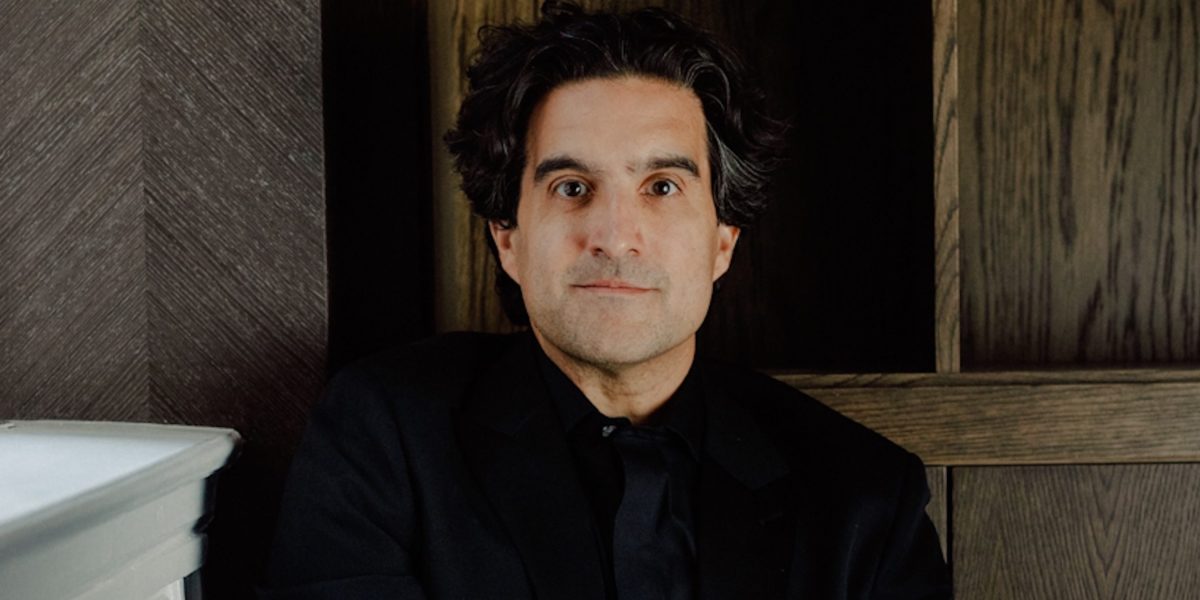
Over the course of his two-decade career, entrepreneur Andy Dunn has launched several businesses and invested in dozens more. One of his biggest moves to date was selling his menswear brand Bonobos to Walmart in 2017 for a whopping $310 million. But behind the glitz of extraordinary business success, Dunn had just gone through one of the most destabilizing periods of his life.
One year before Dunn sold Bonobos, Dunn was confronted with a brewing mental health crisis in a very big way. He had been grappling with a Bipolar I diagnosis ever since college: a mental health condition marked by extreme mood and energy shifts, manic episodes, and depressive slumps. There were days when he was catatonic, and could barely get out of bed, let alone get to the office; other times, he was operating on enormous energy, and an elevated sense of confidence and possibility.
For a while, Dunn had been “in denial” of the diagnosis—but years of mounting stress and compounding circumstances opened the floodgates. Dunn’s Bonobos cofounder had bowed out of the company, executives were cycling in and out, and he was burning through cash on a glitzy New York City lifestyle. One March night in 2016, it all boiled over.
Dunn had a manic episode in his apartment. His head ran wild with the idea that he was the president of the United States and Batman. During his episode, he hit his head on the doorway; his then-girlfriend (and now wife) Manuela rushed in to help stop the bleeding, but in his altered state, Dunn hit her. And when Manuela’s mother also came to help, Dunn fought back against her too. It didn’t take long until eight police officers showed up and were able to restrain him. Dunn then spent a week in a psychiatric ward at Bellevue Hospital in Manhattan, and over the next six months, worked to pick up the pieces with his girlfriend, family, and business.
It was a disastrous moment that completely altered the trajectory of Dunn’s life—for better, and worse. After the episode, he began medication and therapy, closely monitoring his sleep and routine. Dunn says Manuela stayed by his side through the aftermath, including visiting him in the hospital, and the two eventually married. Bonobos kept him on as CEO until the company was sold to Walmart one year later; and ever since, Dunn has opened up about Bipolar I to millions across TED talks and his 2022 book, Burn Rate. The 47-year-old has also used his mental health journey as inspiration for his current social company, Pie: a social media combating loneliness and bringing together people around real-world connection.
“I went through some pretty calamitous events that led to good news on the other side of that, which was getting healthier, acknowledging the condition, being in treatment,” Dunn tells Fortune. “A new chapter of my life opened up once this was all in the light.”
Building Bonobos—and the overlap between entrepreneurship and mental health
For Dunn, the traits that helped him build Bonobos—relentless drive, confidence, energy, and risk-taking—mirrored the same symptoms as his condition.
Dunn was first diagnosed with Bipolar I as a senior at Northwestern University in 1999. Like many college students, he was partying and “burning the candle at both ends” without noticing much of the highs and lows of the disorder. He says he was asymptomatic for around five years after being told of his condition; then, at the age 28, Dunn cofounded his e-commerce brand Bonobos with Brian Spaly. The entrepreneur life “cloaked” his underlying condition, Dunn explains—then the two “amplified each other,” bringing the diagnosis to the forefront.
At the time of founding Bonobos, selling men’s clothing online was still a pretty contrarian idea. Without financial backing, the young founders forked over $60,000 of their own money into making pants, and sold them through trunk shows and word-of-mouth. Within a year, the business hit a $2 million annual revenue run rate. Then, things really took off; Bonobos received $18.5 million in funding from Accel and Lightspeed in 2010, and by November that year, began hitting more than $1 million in monthly sales.
At this point, Dunn says he was living the “bachelor” lifestyle in New York City. Nordstrom had invested $16.4 million in 2012 and began carrying Bonobos in its stores, and within the following two years, Bonobos raised another $85 million. This momentum ultimately led Walmart to acquire Bonobos for $310 million in 2017, when the company was boasting around $120 million in annual sales. The trajectory looked like a classic startup success story—but upon reflection, Dunn can now recognize signs of hypomania, or a sustained period of abnormally elevated high-energy or irritable moods.
“The characteristics of an entrepreneur are really convergent with the diagnostic criteria for what’s called hypomania,” Dunn says. “The flight of ideas, elevated speech patterns, decreased need for sleep, huge amounts of energy for work, bursts of creativity, a feeling that the universe is conspiring on your behalf, delusions of grandeur, risk-seeking behavior…It’s more or less an entrepreneur having a good day.”
It took six months after Dunn’s 2016 manic episode and arrest to finally find a combination of medications that made him feel like himself again. His business and family rallied around him, the case was sealed and expunged, and he has been married to Manuela for nine years. For the past decade, Dunn has checked in with a doctor weekly, and hasn’t missed a single day of medication. Sleeping six to eight hours nightly has also become a “bedrock” in staying healthy, as well as consistent exercise, being out in the sunlight, and changing his relationship with work.
Several years later he founded social media start-up Pie, which connected deeply with his own mental health journey, and seeks to help others combat isolation.
“[Bonobos] was very much wrapped up in my ego and my identity…Whether it succeeded or not was a direct referendum on me as a person,” Dunn says. “And now, with Pie, it’s so important to me that we win, and I have so much belief this is going to be a big and important and enduring company. And I know that it’s a company—it’s not me.”
Founding Pie and turning personal isolation into a new business
Dunn has since carved out a spot in an entirely different industry—one far removed from the world of chinos and dress shirts.
“I loved building a brand that guys love, where you can wear clothing that makes you more confident,” Dunn explains. “Then towards the end of that journey, I was like, ‘You know what? Like, I think I’m done working on making men’s butts look good in their pants.’”
On a quest to find a husband for his mother-in-law, Dunn decided to launch a dating app for seniors. But after the idea initially flopped, he pivoted the platform to help others find platonic relationships. Dunn wanted to build a company that came down to human connection and mental well-being, and it couldn’t come at a better time. Pie was founded in 2020, right around the time the loneliness epidemic was growing in lockdown, and set off with the mission to create a “deeper spirit of belonging, community, in friendship.”
The first two years, Dunn says the app went nowhere—but when he relocated from New York to Chicago, something shifted. Struggling to find social connections of his own, he moved the entire company from The Big Apple to The Windy City, and found that it could finally serve a “neglected market.” Younger crowds started joining Pie, where they could discover or host local events, see what friends and communities are doing, chat, and build recurring connections through interest groups. And despite being stereotyped as being anti-social, Gen Z was a major inspiration for the company; now, they’re leading the wave of online connections.
“I started to notice that Gen Z was getting good at this, running clubs and art markets and watch parties,” Dunn explains. “And I said to myself, ‘If we can build software for those people to empower them, that might be the beginning of a movement to create real meaningful and deeper human connection.’”
Six years into Pie’s company evolution, the app has spread from Chicago out to all 50 U.S. states and 100 cities, with the most users in markets like NYC, L.A., Austin, Boston, and San Francisco. The company has raised $24 million in total, with investors including Ev Williams, Forerunner, Renegade Partners, and Origin Ventures. In July of this year, Pie brought on Nadya Okamoto as a co-founder: originator of popular NYC run club called Zoomies, creator of period care brand August, and social influencer with over 4.4 million TikTok followers. Pie currently has more than 310,000 users looking for their next real-world connection.
If you or someone you know is struggling or in crisis, resources are available. Please dial 988 or chat online at 988lifeline.org for free, confidential help. In case of an emergency, call 911 or visit your local emergency room.
This story was originally featured on Fortune.com
Hence then, the article about one year after a bipolar episode put him in the hospital bonobos cofounder andy dunn sold his company to walmart for 310 million was published today ( ) and is available on Fortune ( Middle East ) The editorial team at PressBee has edited and verified it, and it may have been modified, fully republished, or quoted. You can read and follow the updates of this news or article from its original source.
Read More Details
Finally We wish PressBee provided you with enough information of ( One year after a bipolar episode put him in the hospital, Bonobos cofounder Andy Dunn sold his company to Walmart for $310 million )


Also on site :
- ‘I Play Rocky’ Premieres at TIFF: A Movie About a Best Picture Winner That’s a Best Picture Contender?
- ‘I’m a Rheumatologist—These Are the Symptoms I Ask About Before Suspecting Autoimmune Disease’
- Mortgage lending standards are so tight that homebuyers must have ‘pristine’ credit histories, study says, as sales head for 31-year low